The Power Strip Reckoning: What We Discovered When We Actually Tested Surge Protectors From $8 to $120
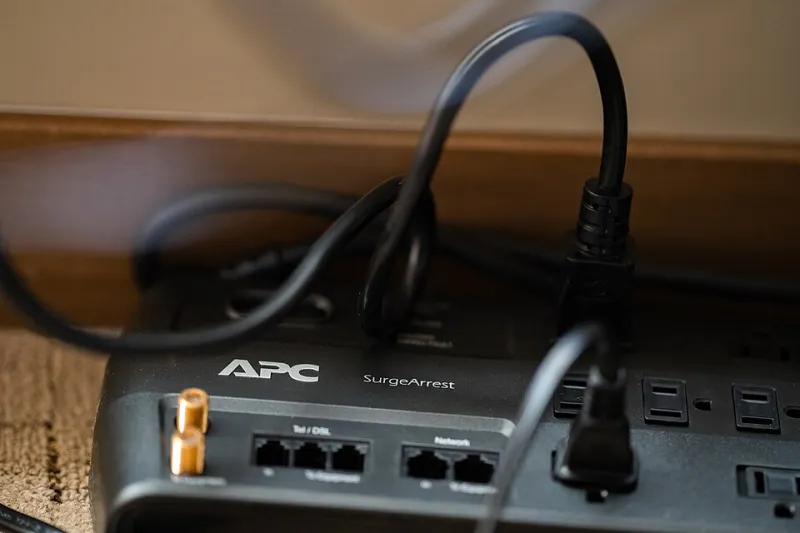
Photo: Tony Webster from Minneapolis, Minnesota, United States, CC BY 2.0, via Wikimedia Commons
There is a power strip plugged into the wall behind your television right now. There may be one under your desk, another behind your entertainment center, possibly a third in the home office. The label on the side almost certainly includes the word "protection." What it probably does not include is any honest accounting of what that protection actually amounts to when your home's electrical system takes a hit.
That gap between marketing language and measurable reality is what drove us to spend six weeks testing twelve surge protectors, ranging from an $8 big-box store find to a $120 premium model marketed specifically to audiophiles and home theater enthusiasts. The results were, in several cases, genuinely alarming.
What a Surge Protector Is Actually Supposed to Do
Before examining what these devices deliver, it helps to understand what they are designed to accomplish. A surge protector's core job is to absorb or redirect voltage spikes — transient overvoltage events caused by lightning strikes near power lines, utility grid switching, large appliances cycling on and off, or even your HVAC system kicking in — before that excess energy reaches your connected devices.
The primary component doing this work is a metal oxide varistor, or MOV. When voltage exceeds a threshold, the MOV absorbs the excess energy and dissipates it as heat. This sounds straightforward. The complications begin when you start asking how fast that response happens, how much energy the MOV can absorb before it degrades or fails entirely, and — critically — whether the device gives any indication when it has stopped working.
The industry uses two key specifications to communicate protection quality: clamping voltage, which is the level at which the device begins diverting excess current, and joule rating, which reflects total energy absorption capacity over the device's lifetime. Neither figure tells the complete story, but both matter considerably more than the number of outlets.
How We Tested
Our evaluation framework centered on three core assessments. First, we used a calibrated surge generator to deliver controlled voltage spikes at 500V, 1,000V, and 2,000V, measuring actual clamping response against manufacturer claims. Second, we examined each unit's response time — the interval between spike onset and diversion — using an oscilloscope. Third, we subjected each unit to repeated surge events to evaluate degradation over cumulative stress, paying particular attention to whether indicator lights accurately reflected the MOV's remaining capacity.
We also consulted with a licensed electrician to contextualize our findings within the realities of American residential wiring, which varies considerably between older construction and newer builds.
The Budget Tier: Worse Than Useless, or Just Honest?
The three units priced under $20 produced the most troubling findings. Two of them — both prominently labeled "surge protector" on retail packaging — showed clamping voltages that were substantially higher than advertised under our test conditions. One unit rated at 330V clamping began diverting only at measured thresholds closer to 500V, a gap large enough to matter for sensitive electronics. The third budget unit performed closer to its specifications but carried a joule rating of just 200J, which an electrician we consulted described as "sufficient for a minor event, but not what you want between your TV and a real surge."
More concerning: two of the three budget models had indicator lights that remained green throughout our degradation testing even after the MOVs showed signs of functional compromise. In practical terms, a homeowner relying on that green light as confirmation of active protection would have no way of knowing the device had effectively become an expensive extension cord.
The Mid-Range: Where the Value Equation Actually Stabilizes
Units in the $30 to $60 range produced the most consistent results relative to their specifications. Three of the four models we tested in this tier clamped within acceptable tolerance of advertised thresholds, and two offered joule ratings above 1,000J — a meaningful improvement in cumulative absorption capacity.
One standout in this range was a model carrying a connected equipment warranty, a feature worth examining carefully. These warranties — which typically promise reimbursement for damaged connected devices up to a stated dollar amount — vary enormously in their actual enforceability. We reviewed the fine print on four such warranties and found that most require documentation of the surge event, proof of device damage, and evidence that the protector itself was the proximate cause of protection failure. In practice, collecting that documentation after a storm is rarely simple.
That said, the mid-range units generally delivered honest performance. For most households running standard consumer electronics — televisions, gaming consoles, desktop computers — this tier represents a reasonable expenditure.
The Premium Tier: Real Advantages, or Engineered Confidence?
The four units priced between $70 and $120 introduced features that require more careful evaluation. Automatic voltage regulation, which smooths out undervoltage conditions as well as overvoltage events, is a genuinely useful addition for areas with unstable grid power — certain rural regions and older urban infrastructure in the US are particularly susceptible to "dirty power" that degrades electronics gradually rather than catastrophically.
Filtering for electromagnetic and radio frequency interference, another premium-tier feature, also has real-world merit for audio and video equipment, though its impact on most everyday consumer devices is marginal.
Where the premium tier disappointed was in the incremental surge protection performance itself. The most expensive unit we tested, despite its $120 price and extensive marketing copy, did not outperform the best mid-range unit in our clamping voltage or response time measurements. It carried a higher joule rating, which is meaningful for longevity, but for households not in high-surge-risk environments, that advantage may never be practically relevant.
What the Testing Actually Tells Consumers
The honest conclusion from six weeks of evaluation is that surge protection quality does not scale linearly with price. The most dangerous products on the market are not the expensive ones — they are the inexpensive ones that use the language of protection without delivering its substance, particularly those with unreliable indicator systems.
For most American households, a mid-range unit from a reputable manufacturer, carrying a joule rating of at least 1,000J, a clamping voltage at or below 400V, and a functioning protection status indicator, represents the practical optimum. Spending beyond that threshold is defensible for home theater setups, audiophile equipment, or homes in regions with known grid instability — but it should be a deliberate choice based on actual need, not a reaction to packaging that implies superior protection without quantifying it.
One additional recommendation from our licensed electrician consultant: no surge protector substitutes for a whole-home surge suppressor installed at the breaker panel. For homes with significant investments in electronics, that hardware-level protection — typically installed for $200 to $400 by an electrician — addresses the category of surge that travels through the panel rather than the outlet, a pathway that no power strip can intercept.
The Bottom Line
The surge protector market rewards marketing fluency more consistently than it rewards engineering quality. Consumers who evaluate these products by outlet count, cord length, and packaging claims are making purchasing decisions on largely irrelevant criteria. The specifications that matter — clamping voltage, joule rating, response time, and indicator reliability — require deliberate attention to find, and in some cases, they require independent verification to trust.
At R10 Review, our position is straightforward: the devices sitting between your electronics and your home's electrical system deserve the same analytical scrutiny you would apply to any other protective investment. In this category, the difference between an adequate product and an inadequate one is not always visible on the shelf — but it becomes apparent the moment the power does something unexpected.