Sitting in Judgment: We Spent Eight Weeks in Gaming Chairs From $150 to $800 to Find Out What You Are Actually Paying For
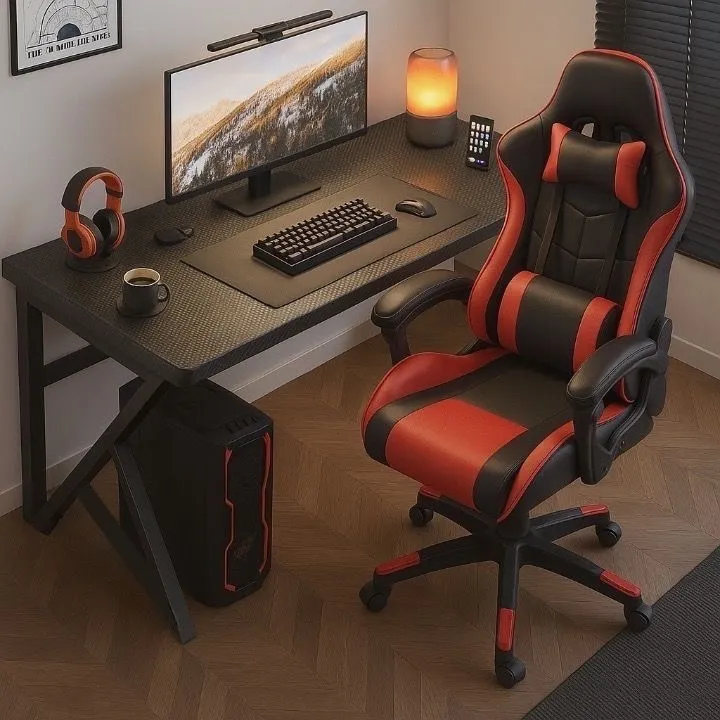
Photo: gaming chair ergonomic office setup comparison desk, via media.karousell.com
The gaming chair industry operates on a straightforward premise: sit better, perform better, feel better. Manufacturers back that premise with dramatic lumbar support claims, high-density foam specifications, and ergonomic certifications that sound authoritative until you start asking what they actually measure. Retail prices range from under $150 to well above $800, and the visual differences between those extremes are often surprisingly minimal.
At R10 Review, we do not accept marketing language as a substitute for evidence. So we sourced five chairs spanning the full price spectrum, recruited four long-session sitters ranging from 5'4" to 6'2" and 130 to 215 pounds, and spent eight weeks collecting structured comfort data, physical measurements, and durability observations. Here is what the numbers — and the aching backs — revealed.
The Five Chairs and What They Cost
Without endorsing specific brands by name in this summary, the test field included a $149 entry-level model sold primarily through big-box retailers, a $229 mid-budget option with adjustable lumbar, a $389 mid-range chair from a well-regarded gaming peripheral brand, a $549 enthusiast model marketed heavily toward esports professionals, and an $799 premium option citing orthopedic design partnerships and aerospace-grade materials.
Each chair was evaluated across four dimensions: measurable ergonomic adjustability, materials and build quality, comfort across extended sessions (two hours, four hours, and six-plus hours), and observed durability over the testing period.
What the Physical Measurements Actually Showed
Before any human sat down, we measured every adjustable parameter on each chair: lumbar pillow positioning range, armrest travel in four axes, seat height variance, recline angle, and seat depth. The results were instructive.
The $149 chair offered fixed lumbar support — a pillow attached by elastic straps with minimal repositioning ability. The $229 model introduced a basic dial-adjustable lumbar mechanism, a meaningful functional upgrade. The $389 chair added seat depth adjustment, which ergonomists consistently identify as one of the most underappreciated variables in long-duration seating comfort.
The $549 and $799 models both offered the broadest adjustment ranges, but the gap between them was narrower than the $250 price difference suggests. The premium $799 chair's lumbar mechanism was smoother and more precise, but its effective positioning range was nearly identical to the $549 model. On raw adjustability metrics alone, the $389 chair delivered roughly 75 percent of the functionality found in chairs costing twice as much.
The Comfort Data Over Time
Testers completed structured sitting sessions and recorded discomfort ratings across seven body zones — lower back, upper back, neck, hips, thighs, shoulders, and wrists — at the two-hour, four-hour, and six-hour marks. Sessions were conducted during normal desk work, not gaming specifically, to isolate seating variables from activity variables.
At the two-hour mark, all chairs performed adequately for most testers. Differences were marginal, and the $149 chair drew no significant complaints from lighter or shorter testers. The divergence began at four hours.
By the four-hour mark, the entry-level chair showed consistent lower back discomfort scores averaging 6.1 out of 10 across testers, compared to 3.8 for the $229 model and 3.2 for the $389 chair. The $549 and $799 models scored 2.9 and 2.7 respectively — a statistically minor difference that nonetheless represented real comfort for users in marathon sessions.
At six hours, the $149 chair's foam compression was visibly noticeable, with testers reporting hip and thigh pressure that had not been present earlier. The $229 model held up better but still lagged behind the mid-range options. Critically, the $389 chair's seat depth adjustment allowed testers to redistribute pressure more effectively as fatigue accumulated — a practical advantage that pure price comparisons tend to obscure.
Materials: Where Premium Pricing Finds Some Justification
Disassembling armrests and inspecting base components revealed meaningful differences in build quality that correlate loosely — but not perfectly — with price. The $149 chair's armrest padding compressed noticeably within the first three weeks. Its gas cylinder, while functional, exhibited minor wobble under lateral load.
The $229 and $389 chairs used sturdier aluminum-reinforced bases and denser armrest foam that retained shape throughout the testing period. Stitching quality on the $389 model was notably superior to the two lower-priced options, suggesting longer upholstery longevity under daily use.
The $549 and $799 chairs employed cold-cure foam with higher ILD ratings — a genuine materials science distinction that translates to slower compression and longer useful life. The $799 model's steel frame components were measurably heavier gauge. For buyers intending to use a chair six or more hours daily for five or more years, these construction differences carry real financial logic. For users sitting three to four hours daily, they represent diminishing returns.
The Mid-Range Finding Nobody Advertises
The most consistent finding across our testing period was the disproportionate value delivered by chairs in the $300 to $450 range. This tier captures the ergonomic fundamentals — adjustable lumbar support, seat depth control, four-directional armrests, and quality foam — without the branding premium that inflates prices above $500.
The $389 chair in our test field outperformed the $549 model on tester comfort scores at the four-hour mark by a margin that was both statistically and practically meaningful, despite costing $160 less. The difference between the $389 and $799 options amounted to roughly half a point on a ten-point discomfort scale after six hours of sitting — an outcome that is difficult to justify as an $410 value proposition for the average home office or gaming setup user.
The $549 and $799 chairs genuinely distinguished themselves for our tallest, heaviest tester, whose body dimensions exceeded the effective support range of the mid-range models. For users at the outer edges of typical sizing — particularly those above 6'1" or over 220 pounds — the engineering investment in premium chairs becomes more defensible.
Where the Marketing Ends and the Product Begins
Gaming chair marketing relies heavily on professional esports associations, influencer endorsements, and visual identity borrowed from motorsport aesthetics. None of those elements have any bearing on lumbar support quality. Several chairs in our test field carried ergonomic certifications from bodies with limited independent authority, and marketing copy on the higher-priced models made clinical-sounding claims that our physical testing could not substantiate.
This is not unique to the gaming chair category — it is a recurring pattern in products where aesthetic appeal and lifestyle branding intersect with functional health claims. Consumers deserve to know the difference.
The Practical Verdict
If your budget is under $200, the $149 tier will serve you adequately for sessions under three hours but will likely produce discomfort and accelerated wear for heavier daily use. Stretching to the $220 to $250 range buys a meaningful ergonomic upgrade.
For most users — those sitting four to six hours daily in a standard home office or gaming context — the $350 to $450 range represents the genuine value apex of this market. You will receive the adjustability that matters, materials that hold up, and comfort scores that rival chairs costing twice as much.
Above $550, you are purchasing incremental durability gains, refined build quality, and in some cases better accommodation of larger body types. If those factors match your specific situation, the premium is defensible. If they do not, you are largely paying for a logo and a racing stripe.
The data is clear. Your lumbar support does not know what brand name is stitched into the headrest.